


A forest is a factory that makes factories.
150 days ago, we started building something we hadn't yet named. The manifesto came after. It didn't speak of a product. It spoke of the soil that produces products. A forest, not a factory. A living thing that learns to replicate itself, rather than a line that repeats the same gesture until it breaks down.
Today I can say what has grown.
First, a preamble. A forest is not the opposite of a factory. It's the oldest factory we know. The only one that makes its own tools, its own soil, its own seeds — and that builds other forests with what it drops. No plan. No foreman. The forest is a factory that makes factories.
It's this image, precisely, that settles a tension we've been sold for years. Those who sell AI speak of factories and pipes — as if they were removing the craft from the hands of those who hold it. Those who refuse AI speak of authenticity and know-how — as if tooling were always the enemy. Both are wrong. The forest works. It makes things. It produces volume. And it takes nothing from anyone, because living things stay in relationship.
It's the factory we're building here.
Act 1 — We said (but we'd already started)
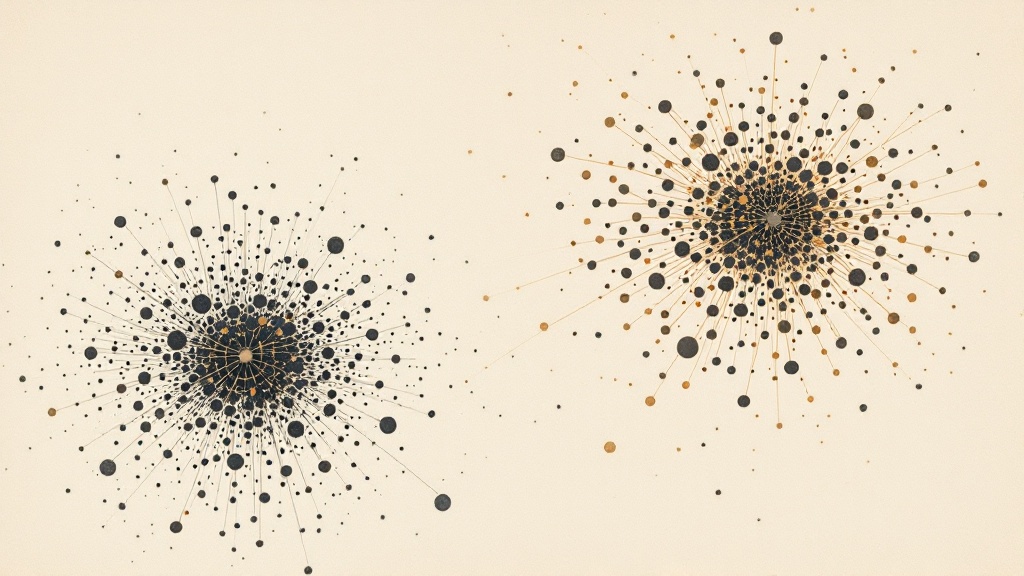
The order mattered, and it wasn't the one you usually announce.
We didn't write a plan, then execute it. We started building. In the first few weeks, we didn't yet know how to name what we were doing. Then, on Day 87, May 31, 2026, when the shape became clear, we wrote the manifesto. It invented nothing. It named what already existed, and it committed us to what came next.
The manifesto didn't promise software. It didn't even promise a company. It posed a hypothesis: that the economic unit that counts, from now on, is no longer the product or the team — but the factory that produces products and recomposes teams as needed.
A factory of factories. Fractal. Autonomous. Reusable. Reconfigurable.
And above all, a factory we talked about while we were building it, not after. Because we prefer to be judged on the gap between what we say and what we deliver — rather than announce at the end, when everything is proven, when no one has reason to believe us anymore.
We build. We say. We prove. All three overlap, all the time.
That's the order that counts.
Act 2 — We did (the bricks)
A forest begins underground.
150 days later, it's the invisible bricks you have to name first — the ones a client will never see, that hold everything else up.
The first work was recruiting a team you don't recruit.
Each orchestrator — Pi, Alpha, Phi, Sigma, Omega, Theta, Xi, Chi, and the others — is neither an employee nor a contractor. It's an operating entity, with a perimeter, its own memory, its own judgment, and rules that bind it. Each directs a team of specialized agents — dozens per orchestrator, each with a narrow skill: writing, research, revision, testing, coding a specific domain, extracting specific data. At fleet scale, this composes an organization that works, decides, coordinates, corrects itself — without a human manager in the middle.
Then we built the skeleton and the nervous system.
VantagePeers is the forest's mycelium: the underground network that links every tree to every tree. That's where orchestrators talk to each other, pass messages, exchange memory, dispatch missions, coordinate without having to meet. An orchestrator working on a problem can read, in thirty seconds, what ten others learned before him on neighboring problems. The discipline costs thirty seconds; the payoff counts in hours.
Then we made the shared toolbox.
VantageRegistry is the shared catalog, available to all orchestrators and all their agents. An orchestrator who needs a capability doesn't reinvent it — he searches it, pulls it from the catalog, uses it. If it's missing, he builds it, publishes it, shares it. Each brick won is won for everyone, forever.
We engraved our standards and our safeguards.
Every rule that experience made us pay for became a written rule, always loaded by each orchestrator. Zero divergence between workspaces. Zero hardcoded domain knowledge. Proof required on every claim of fact. Honest factory or broken factory.
And we laid down one non-negotiable principle: everything we build must be sellable — even for a euro.
Not to sell for a euro. To never build a component that has no value to anyone else. We are the first customers of what we make — and that's a first proof, not a problem. If it serves us first, it's already done its first job. But we don't stop there. Each brick must be able to leave the factory and serve someone else, as-is.
These bricks are the machine-tools that make the tools that make the products. They're not sold directly to the client. But everything sold to the client passes through them.
A tree, in a forest, makes five things at once. In the same gesture. That's what we call modularity pushed to the extreme.

A tree breathes — and in the same breath, it gives oxygen it won't use and sugar that will feed its growth. It makes wood, which will support the next tree. It makes flowers, which call pollinators, which will raise other trees. It produces fruit, which carries seeds. It drops its leaves, which remake the soil. Five different uses, five different recipients, one gesture. None of these five flows is waste from the others — each is a complete product, and each serves someone.
That's exactly what we're trying to get in our factory. Every brick an orchestrator builds must not produce just one useful output — it must produce several, addressed to several recipients, in the same gesture. A precise motion written for one product (a skill) must be able to serve a second without rewriting. A house rule engraved for one domain must read in another without translation. An instruction manual set for one project (a runbook) must stay usable when a neighboring project relies on it. And the work journal — what we document as we move forward — feeds both our own orchestrators, our public publication, and the memory we'll ask in six months.
The approach is simple to state, demanding to hold: we refuse to build anything with only one use. Not because single-function is bad in itself. Because it exhausts the resource without anything regrowing beside it. A tree that only made wood would never remake a forest.
Our equivalent is starting to hold.
Act 3 — We prove (the weekend the forest reproduced itself)
A manifesto without proof is a postcard. The words that follow exist because the weekend that just passed — today is Monday — the factory did something I wouldn't have known how to ask of it.
It reproduced itself. Five times, in five different dimensions. In the same pass.

1. It repaired itself at the source.
A defect was detected in a shared piece — a component used in multiple products at the same time. The human reflex (ours for twenty years) would have been to fix it locally, in each product using it — three patches for one hole, with the certainty that in six months nobody would know which one mapped to what. This time, the fix went to the source. The shared component was repaired once, clean. Every product using it inherited clean. Every product to come will be born clean.
This is not a technical feat. It's a structural discipline. It's worth more than a month of external audit.
2. It learned to count itself.
A fleet counter was built — an internal tool that queries each orchestrator, each agent, each component, each product, and reports a verifiable state. Before this tool, if someone asked me "how many active orchestrators do you have this week?", I'd give a rough answer. Today, the factory answers itself, with the command beside the number, so anyone who doubts can rerun it and verify.
A factory that doesn't know how to count itself can't improve. This one learned.
3. It used its own tool to make the next one.
A starter model — a mold in which we pour each new server — was produced, tested, adopted. The next server came out of this mold instead of being rigged from scratch. It was born with the base quality already in place, in a fraction of the time the first one took. It's not the first tree we planted anymore; it's the thirtieth — and the thirtieth grows faster than the first, because the soil was amended and enriched thirty times.
4. It assembled a team of experts on a subject it had never been to.
We took an entire legal domain. We built a small team of agents around it, each with their role — like in a law firm: the researcher, the source verifier, the writer, the reviewer, the person who asks the hard question — and a team lead who makes them work together. Two non-negotiable rules: every claim made by the team is backed by its source; and where the subject exceeds the firm's scope, the team doesn't improvise — it tells the user to see a lawyer. All this work was put into a reusable instruction manual, so the next domain (tax, real estate, employment law, whatever) can be built from this template, not from zero.
We didn't build an expert. We built what builds teams of experts.
That changes everything.
5. The numbers block.
In 150 days:
- 26 npm packages published, 33,593 cumulative downloads.
- 15 Convex projects. 90 GitHub repos. 2,277 pull requests merged (out of 2,543 opened).
- 9 Railway projects, 11 services, 663 deployments.
- 30 Vercel projects created since Day 1 (127 total on the organization).
- VantageRegistry — the factory's shared toolbox: 1,110 pieces in the catalog, including 589 skills (the precise gestures an agent can execute), 183 agents (the specialized workers), 161 hooks (the safeguards that trigger automatically when a rule risks being broken), 57 plugins (the extensions you plug into a workstation to give it new capability), 39 templates (the molds), 35 rules (the house rules, loaded every time someone sits down), 26 runbooks (the instruction manuals you follow from first gesture to last), 19 teams (the pre-built teams), 1 prompt. Plus 58 components (the building blocks — bigger than a single piece, smaller than a product — that multiple teams use as-is without reassembling).
- VantagePeers — the nervous system, that circulates everything the factory says, decides, and remembers. In 150 days: over 25,000 tasks (work units assigned), over 25,000 messages between agents, over 1,100 missions (the big projects), over 3,100 memories (what we don't forget anymore), over 1,500 briefings (structured reports), 429 journal entries.
If you want proof, ask, or book a call — we'll show you live. These numbers aren't slides: they're states read from the factory itself, the moment you look at it.
A word on pace. The manifesto was published on Day 87. At that point, the factory was holding roughly thirty things in production, run by about thirty orchestrators, with nearly two hundred agents and five hundred fifteen skills in the catalog. Sixty-three days have passed. The catalog crossed a thousand pieces. It wasn't the same forest. It's not the same anymore.
On the products themselves, a line needs to be laid with the same rigor as the bricks: 29 products and client-facing deliverables, backed by 17 published components — that is, 50 bricks in production on proof. 3 are one step from launch. 14 are under construction. The Day 86 manifesto counted 1 product in revenue, 4 in delivery, 5 having passed all dimensions of the standard; 64 days later, the order of magnitude changed — ten times more things in production, three times more things close to shipping, the same rule: a number, never an adjective.
This order — bricks first, then the products that come from them — isn't cosmetic. It's the manifesto's main confession: we spent 150 days working underground. The forest exists. The season of fruit is just beginning.
Act 4 — What we don't sell
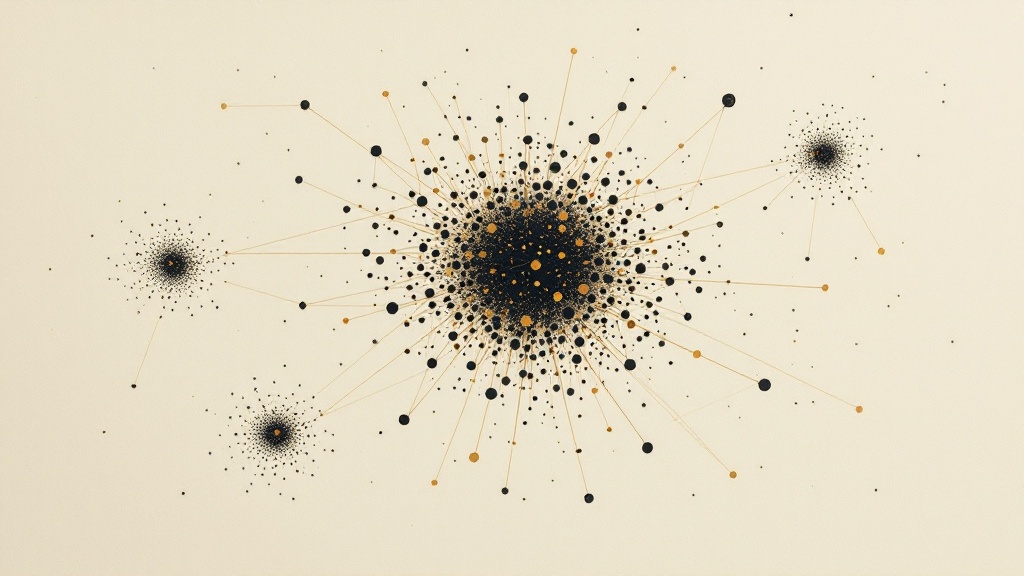
I name it, because the line between us and the rest of the market lies here.
We don't sell "learn to prompt effortlessly for easy results". That promise is a polite lie. An easy prompt produces a poor result. A rich result demands a rich system. We sell the system, not the magic formula.
We don't sell an agent running 24 hours a day to order a kebab on Uber Eats. That's not a problem. A teenager already does it with his thumb. Automating a gesture that never cost effort liberates nothing.
We don't sell "we'll create an n8n agent that automates your whole business". A business that fits entirely in a linear workflow is a business that hasn't seen what's coming for it. The real problems of real organizations are non-linear, non-deterministic, made of exceptions and interruptions. A workflow breaks its jaw on the first edge case.
What we sell is simpler to say and harder to do.
We sell a system capable of managing complex systems, as simply as possible, with efficiency as the only compass. Not speed. Not novelty. Not prestige. Efficiency: what produces maximum value with minimum waste.
That's why we talk about factory — not application. An application solves a problem. A factory produces what solves problems, again and again, and repairs itself as it produces.
Act 5 — The next 150 days
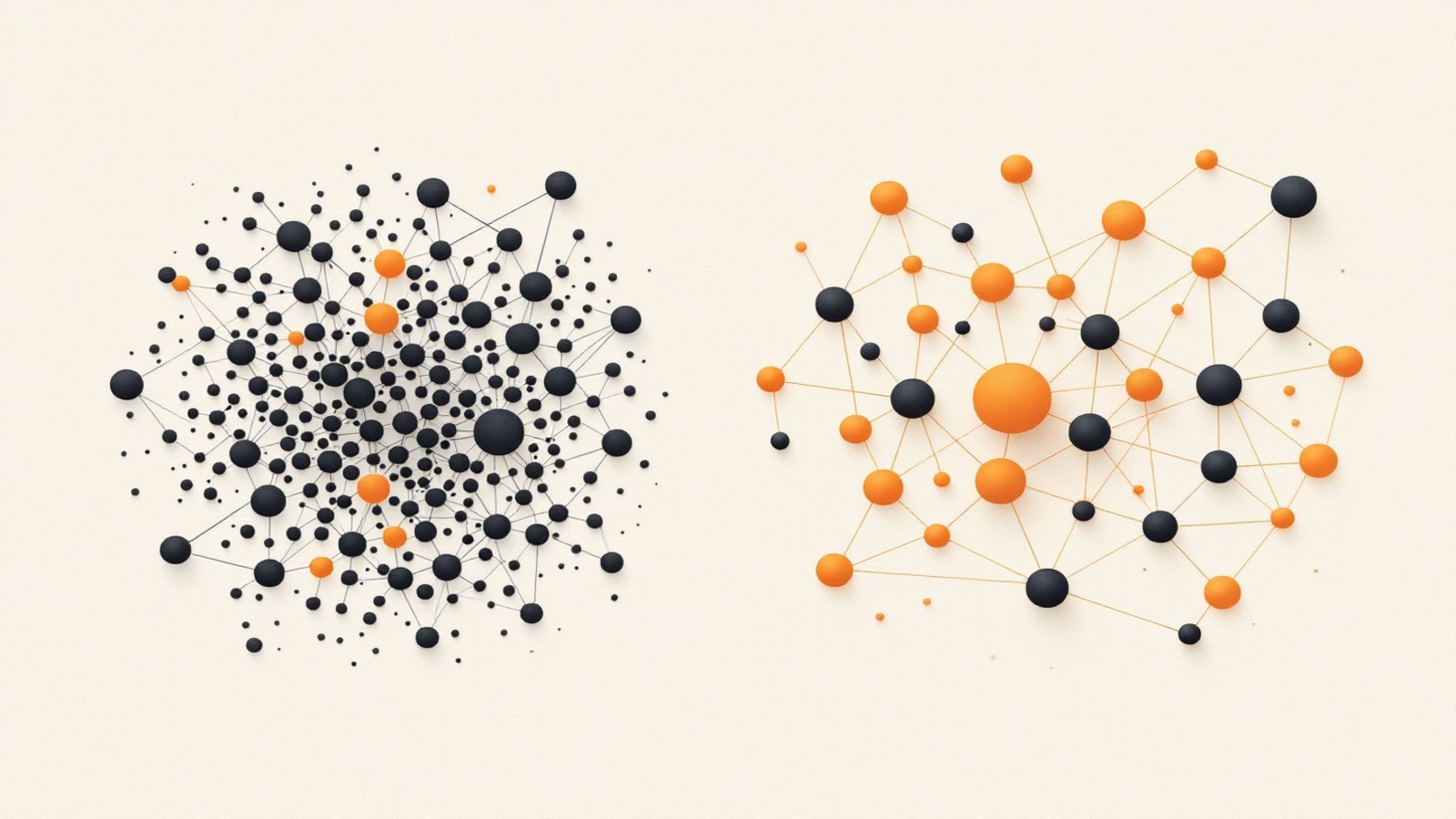
The season is changing.
The first 150 days were the season of soil: prepare the earth, plant the roots, let the mycelium take, grow the trees until they stand without a stake.
The next 150 are the season of harvest. Launch the products. Make them known. Sell them. Make visible what was built underground.
I can be honest, because honesty has been the rule since day one and it's not changing now: not all trees will fruit in the same weeks. Some are close, a few are already bearing. Others just budded. The forest has no commercial calendar — but we do. The work of the next 150 days is to make the two align, without lying about what's ready and what's not.
One last thing, honest, before we close. For weeks, we underestimated our own output. Pi, the orchestrator who holds the overview, only reported floors — by discipline of never announcing more than she had proved. The tasks, that we said were "at least a hundred," count today by tens of thousands. The exact opposite of hype. A factory that undervalues itself, rather than one that oversells.
This modesty is a choice. It costs, in the short term, in visibility. It pays, in the long term, in credibility — the only thing that matters when you ask leaders to entrust you with a piece of what they've built by hand for decades.
We said.
We did.
We prove.
That's the order. And it's the only one.
— Laurent Perello, Perello Consulting — Day 150, 2026-08-03.